
Red Team Scenarios – Modelling the Threats

Introduction Yesterday organisations were under cyber-attack, today even more organisations are under cyber-attack, and tomorrow this number will increase again. This number has been increasing for years, and will not reverse. Our world is getting smaller, the threat actors becoming more emboldened, and our defences continue to be tested. Any organisation can become a victim […]
Red Teams don’t go out of their way to get caught (except when they do)

Introduction In testing an organisation, a red team will be seeking to emulate a threat actor by achieving a specific goal – whether that is to gain administrative control of the network and prove they can control backups (a kin to how many ransomware operators work), through to proving access to financial systems, or even […]
To you it’s a Black Swan, to me it’s a Tuesday…

Cybersecurity is a discipline with many moving parts. At its core though, it is a tool to help organisations identify, protect, detect, respond, and recover, then adapt to the ever-evolving risks and threats that new technologies, and capabilities that threat actors employ through threat modelling. Sometimes these threats are minor – causing annoyance but no […]
The Value of Physical Red Teaming
Introduction In testing an organisation, a red team will be seeking to emulate a threat actor by achieving a specific goal – whether that is to gain administrative control of the network and prove they can control backups (a kin to how many ransomware operators work), through to proving access to financial systems, or even gaining […]
Red Teams – Supporting Incident Response
Unauthorised access into remote computers has been around since the 1960s but since those early days organisations and their IT systems have become complex, and that complexity is increasing at an exponential rate, making securing those systems increasingly difficult. Defence mechanisms like firewalls, antivirus software, and monitoring systems have become essential, but they aren’t enough […]
Flawed Foundations – Issues Commonly Identified During Red Team Engagements

Cybersecurity Red Team engagements are exercises designed to simulate adversarial threats to organisations. They are founded on real world Tactics, Techniques, and Procedures that cybercriminals, nation states, and other threat actors employ when attacking an organisation. It is a tool for exercising detection and response capabilities and to understand how the organisation would react in […]
WordPress AI Plugins: Tell me a secret

In our previous blog ‘WordPress Plugins: AI-dentifying Chatbot Weak Spots’ (https://prisminfosec.com/wordpress-plugins-ai-dentifying-chatbot-weak-spots/) a series of Issues were identified within AI related WordPress plugins: Today, we will be looking at further vulnerability types within these plugins that don’t provide us with the same adrenaline rush as popping a shell, but clearly show how AI plugins are being rushed […]
Why CISOs Need an Adversarial Mindset in Cybersecurity

Chief Information Security Officers (CISOs) are tasked with safeguarding an organisation’s most valuable assets: its data, intellectual property, and reputation. The role of a CISO has evolved from being an overseer of IT security to a strategic leader who must: anticipate and mitigate complex cyber threats, act as the board’s expert in cybersecurity matters which […]
Linux RCE – Critical Vulnerability (CVE9.9) in CUPS – Security Awareness Messaging
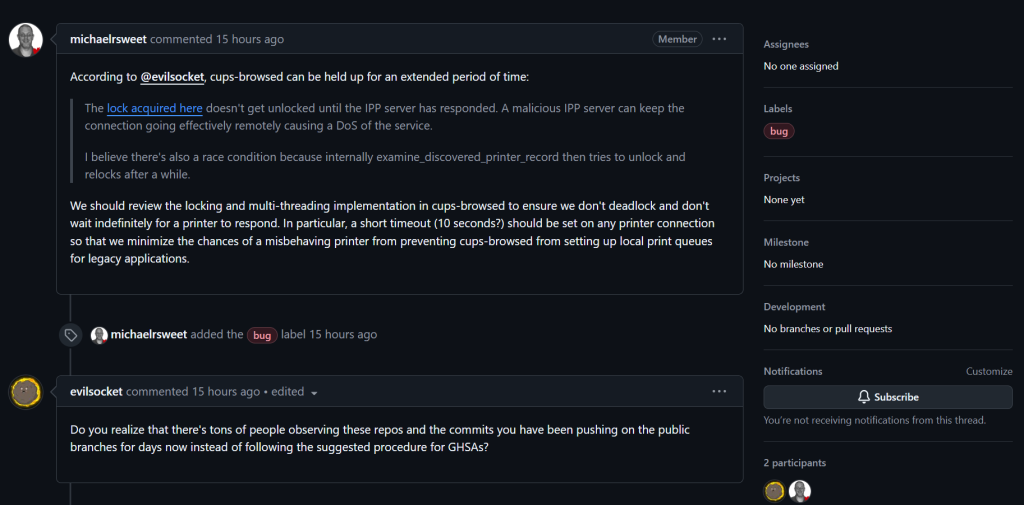
An inadvertent data leak from a GitHub push update identified an RCE in the Linux Common Unix Printing System (CUPS) service, as an unauthenticated Remote Code Execution vulnerability with a CVE score of 9.9. The vulnerabilities: CUPS and cups-browsed (a service responsible for discovering new printers and automatically adding them to the system) ship with […]
Layered Defences: Building Blocks of Secure Organisations

Every organisation is different in terms of how it uses data, how its processes work, and how their staff conduct themselves. As a result no single security tool, deployment, implementation, or capability can protect them. Layered defences, also known as “defence in depth,” is the approach of implementing multiple layers of security controls to protect […]
