

If you are responsible for protecting an organisation’s systems, data or digital services, penetration testing is likely to be one of the most recognisable forms of cyber security assurance. It is also one of the most misunderstood. Many organisations know they need a penetration test, often because of customer requirements, regulatory expectations, a cyber insurance requirement, a major change programme or maybe an annual assurance cycle, however the real value of penetration testing is not simply in producing a report, its value lies in showing, in a controlled, risk managed and authorised way, what a real attacker might be able to do if they targeted your environment. For readers searching “what is penetration testing and why is it important?”, this practical view is key: the purpose is to evidence risk, not just describe it.
At its simplest, penetration testing, often shortened to pen testing (and performed by pen testers), is an authorised, simulated cyberattack against a system, network, application, cloud environment or wider IT infrastructure. Industry body CREST (Cyber Security Services, Accreditations & Training – CREST) describes penetration testing as involving a combination of automated and manual techniques to identify and exploit known and unknown threats. In practice, pen testers use tools (often a combination of opensource, commercial and proprietary), techniques, manual investigation and professional judgement to identify weaknesses, validate whether they can be exploited, and explain what the business impact could be if those weaknesses were used by a genuine threat actor.
This is why a good penetration test should be more than a technical exercise. It should help an organisation understand where its defences are strong, where they need improvement, and which remediation activities should be prioritised first once the report has been delivered. That is also why “what is penetration testing and why is it important?” is best answered in terms of business assurance, not only technical testing.
Penetration testing is not just vulnerability scanning
One common mistake is to treat penetration testing and vulnerability scanning as the same thing. Automated scanning has an important role to play as it can identify known vulnerabilities quickly and depending on set up frequently due to the low cost of it, to support repeatable checks across large environments and provide useful coverage where systems change frequently. However, vulnerability scanning alone rarely tells the whole story and is really best used as part of a wider assurance programme. Another common search question is “what is penetration testing and vulnerability”; in practice, this is where the distinction between identifying weaknesses and validating exploitable risk becomes important.
A penetration test goes further by asking the practical question: what could an attacker actually achieve? This helps answer “what is penetration testing and vulnerability” by showing how vulnerabilities behave in context, rather than treating them as isolated technical issues. A vulnerability may exist, but it may not be exploitable in your environment due to a number of reasons (access requirements, FW configurations, whitelisting during testing all play a part. Equally, a combination of individually moderate weaknesses may create a much more serious attack path when chained together. This is where experienced pen testers add value. They interpret technical findings in context, test assumptions, validate risk and explain the likely consequences in a way that supports decision making all whilst providing evidence and practical guidance to help reconstitute the finding to help your business remediate.
The National Cyber Security Centre (NCSC.gov.uk) describes penetration testing as a method for gaining assurance in the security of an IT system by attempting to breach some or all of that system’s security using the same tools and techniques as an adversary might. That definition is useful because it emphasises assurance, not just discovery. The purpose is not simply to produce a list of weaknesses, but to understand whether your security controls, processes and assumptions stand up under realistic conditions.
What does a penetration test help you understand?
A well scoped penetration test should help answer several important questions such as;
- Are your externally facing systems exposed to common or emerging vulnerabilities? Are access controls working as intended?
- Could a user move from one area of the network to another if they gained an initial foothold? Are cloud services configured securely?
- Could sensitive data be accessed, altered or exfiltrated?
- Are authentication, authorisation and session controls functioning correctly?
- Are security controls being bypassed in ways that are not obvious from policy documents or dashboard outputs?
These questions matter because attackers rarely behave in a controlled or linear way, instead they look for the easiest route to a valuable outcome. That may involve exploiting a vulnerable service, abusing weak credentials, finding an exposed administration interface, misusing excessive privileges, chaining application flaws, or taking advantage of a misconfigured cloud service. Often they will use known vulnerabilities that exist and will try and apply to your companies applications and infrastructure for an ‘easy win’. Penetration testing helps organisations understand these routes before a real criminal, insider or hostile actor finds them first – ideally with penetration testing performed as part of an assurance programme.
For senior stakeholders, the value is often in understanding business risk rather than technical detail alone. A finding such as an insecure direct object reference, weak segmentation rule or exposed management interface may not mean much outside the security team, but if that weakness could lead to unauthorised access to customer data, disruption of a business critical service or compromise of privileged accounts, it becomes an executive level risk that needs to be prioritised accordingly for remediation. For organisations trying to understand “what is penetration testing and vulnerability”, this is where technical findings become business decisions.
Validating security controls under real-world conditions
Security controls can look effective on paper. Firewalls, endpoint protection, cloud policies, identity controls, monitoring tools, vulnerability management processes and secure development practices all play an important role. However, organisations need assurance that these controls work together in practice.
Penetration testing provides that assurance by testing controls in conditions that are closer to real life. It can show whether a vulnerability can be exploited, whether access can be escalated, whether segmentation prevents movement, whether sensitive data is properly protected and whether defensive teams receive the alerts they expect. In more mature environments, penetration testing can also help validate detection and response capability by showing whether suspicious activity is logged, escalated and investigated in a timely way, this is known as ‘purple teaming’. This is particularly important for organisations that have invested in security tooling and complex SOC’s but still need confidence that the configuration, processes and operational response are effective. A penetration test can identify gaps between the control that was intended and the control that is actually operating.
Turning findings into action
The output of a penetration test should not be a list of technical observations, it should provide an easily interpretable report with actionable findings that help internal teams understand the risk presented, patch vulnerabilities, fix misconfigurations, improve access controls, harden systems, address insecure coding patterns and strengthen operational processes.
A strong report should include a clear executive summary, findings with risk ratings, evidence of exploitation where appropriate, practical remediation guidance and enough technical detail for the relevant teams to reproduce and resolve the issue. It should also distinguish between urgent risks that need immediate action and lower priority improvements that can be managed through normal change processes.
A good penetration testing partner should help you focus effort where it will reduce risk most effectively. That means explaining not only what was found, but why it matters, what the likely impact is, how it can be remediated and whether retesting is required to confirm the fix.
When should organisations conduct penetration testing?
Penetration testing is often conducted annually for smaller businesses, but the right frequency depends on the organisation, the risk profile and the pace of change. Testing should be considered when launching a new application or service, after significant architectural changes, following cloud migration, before handling sensitive data, ahead of regulatory assessment or upcoming M&A activity, after major supplier or integration changes, or when an organisation wants independent assurance of their business systems.
For organisations with complex or fast moving environments, penetration testing should form part of a wider assurance programme rather than being treated as a one-off exercise. Vulnerability management, secure configuration, patching, code review, cloud posture management, security monitoring and incident response testing all have a role to play. Penetration testing can then be used to validate whether those activities are effective and to provide independent challenges where required.
Scoping matters
The quality of a penetration test depends heavily on the quality of the scope and before testing begins, it should be clear what is in scope, what is out of scope, what techniques are permitted, which systems are sensitive, who needs to be notified, what the escalation route is for critical findings and how the organisation wants communication to work during the engagement.
This is not just an administrative step. Poor scoping can lead to missed risks, duplicated effort, operational disruption or findings that are difficult to act on. Good scoping ensures the test is proportionate, risk-based and aligned to the organisation’s objectives. It also helps testers focus their time on the areas that matter most, such as internet facing assets, identity platforms, privileged access, sensitive data flows, business-critical applications, APIs, cloud environments or internal network segmentation.
What should you expect from a good penetration testing partner?
A good penetration testing partner should bring more than technical capability. They should be able to help define the scope, explain the testing approach, work safely within agreed rules of engagement, communicate clearly during testing, escalate urgent issues quickly and provide findings that are both technically accurate and commercially useful.
Recognised accreditations and consultant credentials can provide useful assurance. Depending on the sector and requirement, this may include CREST, Cyber Scheme, NCSC CHECK or other relevant certifications, however, accreditation should be supported by evidence of methodology, quality assurance, secure data handling, consultant experience and clear reporting when selecting a partner to work with. Always ask for a sample report so you know what to expect and how to interpret the results too.
Conclusion: penetration testing should improve security, not just evidence it
When people ask, “what is penetration testing and why is it important?”, the simplest answer is that it provides controlled evidence of how real weaknesses could affect the organisation.
Penetration testing is valuable because it turns theoretical risk into practical evidence. It helps organisations identify weak spots before attackers do, validates how well security controls operate under realistic conditions, and produces actionable findings that can be used to strengthen the overall security posture.
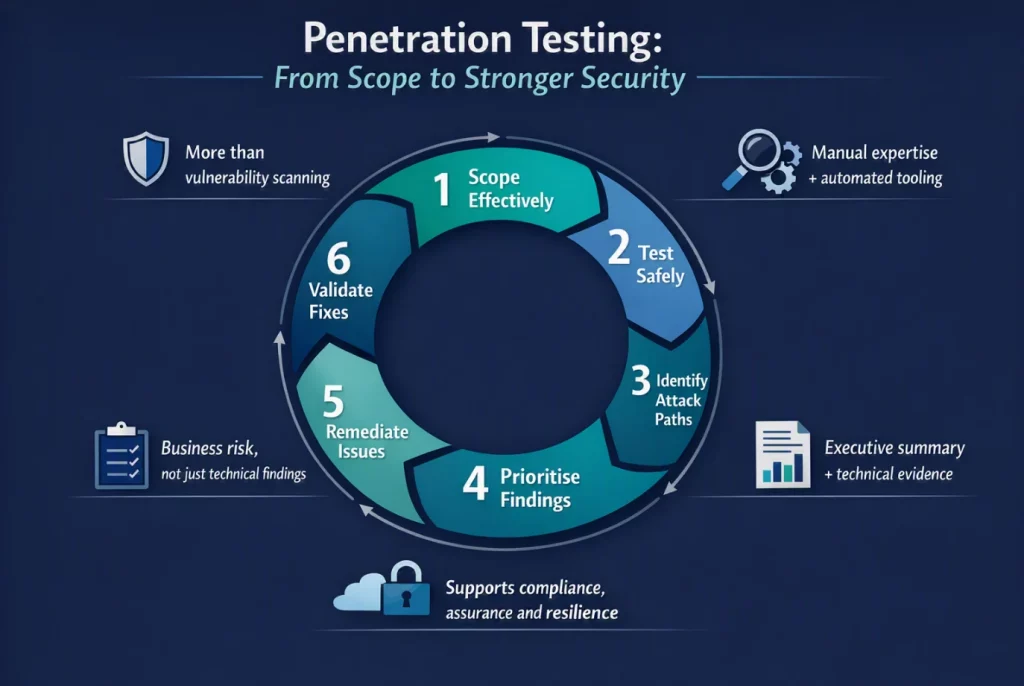
Used properly, it should not be viewed as a tick box exercise or a last minute compliance activity. It should form part of a continuous improvement cycle: scope effectively, test safely, understand the findings, remediate the issues, validate the fixes and apply the lessons learned across the wider environment.
Next Steps
At Prism Infosec, our approach is built around controlled, consultant led testing that combines automated tooling with manual investigation, exploitation validation and risk analysis. The objective is to provide clients with clear assurance, practical recommendations and confidence that findings can be understood, prioritised and remediated effectively.
If you are planning a penetration test or want to understand which type of assessment is right for your organisation, contact Prism Infosec to arrange a call. Our team can help you define the right scope, deliver controlled testing and provide expert guidance on remediation and next steps all of which can be managed through our bespoke end-to-end platform LuxisAI which can manage all of your penetration testing projects.
Image source: Envato